
The production process of PVC ball valves involves precision craftsmanship and high standard material control, with the following core steps:
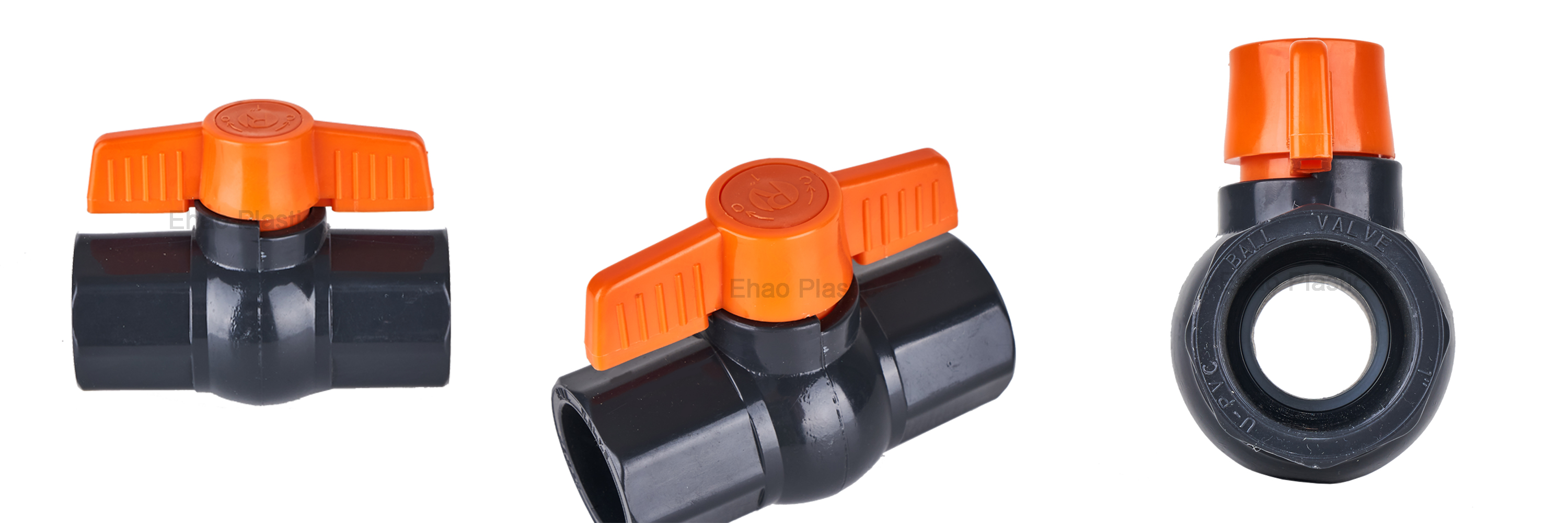
1. Material selection and preparation
(a) Using engineering plastics such as PP (polypropylene) and PVDF (polyvinylidene fluoride) as the main materials to ensure high cost-effectiveness and corrosion resistance; When mixing, it is necessary to accurately mix the masterbatch and toughening agent, and after the strength meets the standard, the mixture should be heated to 80 ℃ and stirred evenly.
(b) Each batch of raw materials must be sampled for pressure resistance parameters and melt index, with an error controlled within 0.5% to prevent deformation and leakage.
2. Valve core production (integrated design)
(a) The valve core adopts an integrated structure, and the valve stem is fixedly connected to the valve ball. The material can be selected from metal (such as increasing strength), plastic (such as lightweight), or composite material (such as plastic wrapped metal).
(b) When machining the valve core, use a three-step cutting tool to cut the diameter part, reducing the cutting amount by 0.03 millimeters per stroke to reduce the breakage rate; Add graphite sealing layer stamping at the end to enhance corrosion resistance
3. Valve body injection molding
(a) Place the integrated valve core (including valve ball and valve stem) into a customized mold, heat and melt the plastic material (commonly polyethylene, polyvinyl chloride or ABS), and inject it into the mold.
(b) Mold design needs to be optimized: the flow channel adopts a three cycle distributed melt, and the corner corners are ≥ 1.2 millimeters to prevent cracking; The injection parameters include a screw speed of 55RPM to reduce air bubbles, a holding time of over 35 seconds to ensure compaction, and staged control of the barrel temperature (200 ℃ for coking prevention in the first stage and 145 ℃ for molding adaptation in the later stage).
(c) When demolding, adjust the temperature of the fixed mold cavity to 55 ℃, with a slope greater than 5 ° to avoid scratching, and control the waste rate below 8%.
4. Assembly and processing of accessories
(a) After the valve body cools down, install the valve cover, seals, and fasteners; Set up an induction locator online, which will automatically trigger an alarm if the deviation exceeds 0.08 millimeters, ensuring precise alignment of accessories such as channel dividers.
(b) After cutting, it is necessary to verify the gap between the valve body and the valve core, and if necessary, add filling box inserts to optimize the sealing structure
5.Testing and Inspection
(a) Perform air-water circulation testing: inject 0.8MPa pressure water for 10 minutes and check the deformation amount (≤ 1mm is qualified); The rotation torque test is set with 0.6N · m overload protection.
(b) Sealing verification includes air pressure testing (observation with soap water at 0.4-0.6MPa) and shell strength testing (holding at 1.5 times the working pressure for 1 minute), with a full inspection standard covering more than 70 national standard requirements.
Post time: Aug-08-2025